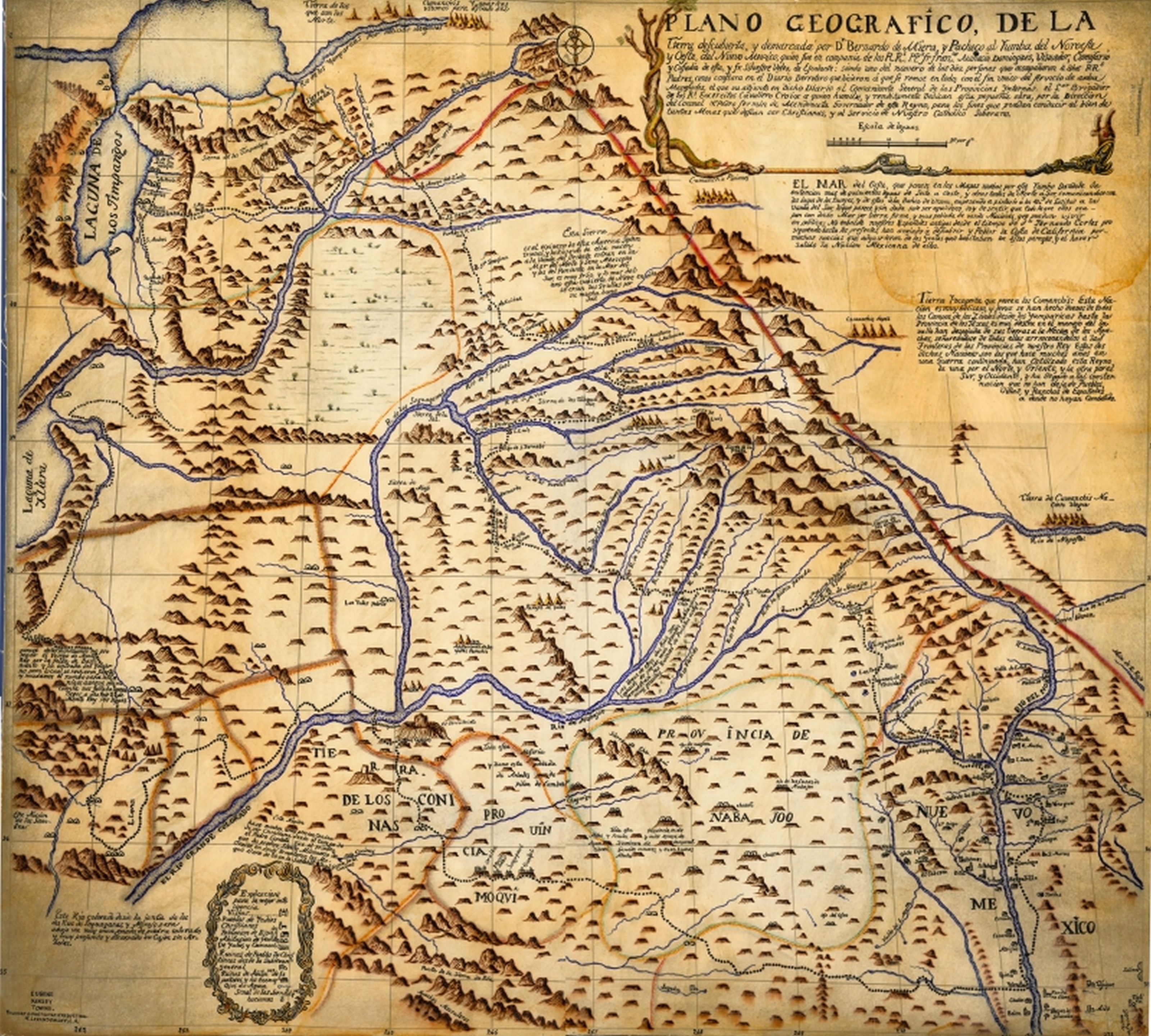
Bernardo de Miera y Pacheco
- Born: 4 Aug 1713, Valle de Carriedo, Burgos, España 250,252
- Baptized: 13 Aug 1713, Santibanez, Santander, España 250,252
- Marriage: María Estefania de los Dolores Domínguez de Mendoza on 20 May 1741 at Iglesia del Presidio de San Felipe y Santiago de Janos, Chihuahua, , Nueva España. 250
- Died: 4 Apr 1785, Santa Fé, Nuevo Méjico, Nueva España at age 71 250,252
 Noted events in his life were: Noted events in his life were:
• Military Service. 250
Don Bernardo Miera y Pachéco, enlisted 11 Jan 1779, Sonora Expedition 1780/81, farmer, son of Capt of the Cantabrian Cavalry Luís Miera and Ysabel Ana Pachéco of Vallé de Carriedo Montañas, 1785, distinguished soldier. Estéfania Domínguez de Mendoza (b in Chihuahua - 13 Dec 1783, SF, La Castrense), and their children include Anacléto and Manuel.
He was Alcálde Mayor of Galisteo and Pecos in 1756. Accompanied Frays Domínguez and Escalânte as guard commander and explorer on their famous expedition to the Great Basin, producing a detailed map in 1779.
He carved the wooden statue of San Felipe still to be seen on the high altar of San Felipe Pueblo.
From Beyond Origins - New Mexico Colonial Patriots, 1779-1783
• Point of Interest. 410
Bernardo de Miera y Pacheco is known as the first known Spanish artist in New México. He was a santero and he carved an image of San Rafael made in 1780. He was famous for the Castrense altarscreen which is now located at the Cristo Rey Church in Santa Fe.
• Background Information. 252
From Origins of New México Families, page 229-230
"Bernardo Miera y Pacheco, a Captain in the Cavalry of Cantabria, was a native of Valle de Carriedo of the Mountains of Burgos in Spain. His father was a Don Luis de Miera who served under the Conde de Aguilar in the Army of Philip V. His grandfather, Don Antonio Pacheco, Governor of Navarra and Colonel of the "Terzio" of Lombardy, died in the battle of Mantua. His mother's name was Isabel Ann Pacheco.
Bernardo arrived in Santa Fé as early as 1756, when he was Alcalde Mayor of Galisteo and Pecos. In a Memorial which he wrote to the Spanish King, he said that he had arrived at El Paso del Norte in 1743, where he first resided and participated in five campaigns. From there he moved to Santa Fé with his family at the beginning of Governor del Valle's term, when he was made Alcalde and War Captain of Pecos and Galisteo.
Bernardo was an accomplished jack-of-all trades. He carved the wooden statue of St. Philip the apostle still to be seen on the high alter of San Felipe Pueblo. He accompanied Father Domínguez and Veléz Escalante as guard commander and explorer on their famous tour of exploration, from which noteworthy maps from his hand came into being, including a detailed map of New México in 1779. He was also a charter officer and first secretary of the Confraternity of Our Lady of Light.
The wife who came with him was Estefánia Domínguez de Mendoza, evidently a member of the old New México family which settled in Chihuahua instead of returning north with the Reconquest. She died in Santa Fé on December 13, 1783; her husaband followed her on April 11, 1785.
They had two sons: Anacelto and Manuel."
Fray Angélico Chávez
• Web Reference: Story Behind Bernardo Miera y Pachéco's New Mexico Map.
• Mas Allá: Bernardo de Miera y Pacheco and the Eighteenth Century Kingdom of New Mexico from the New Mexico Historical Review, Volume 88, No. 2, Spring 2013 by John. L Kessell.
• Web Reference: Bernardo Miera y Pacheco From New Mexico History.org. • Web Reference:
A sense of realism: Spanish colonial artist Bernardo Miera y Pacheco
• Web Reference: Bernardo Miera y Pacheco's Map of the Río Abajo & Bernardo Miera y Pacheco's Map of the 1776 Domínguez Escalante Expedition
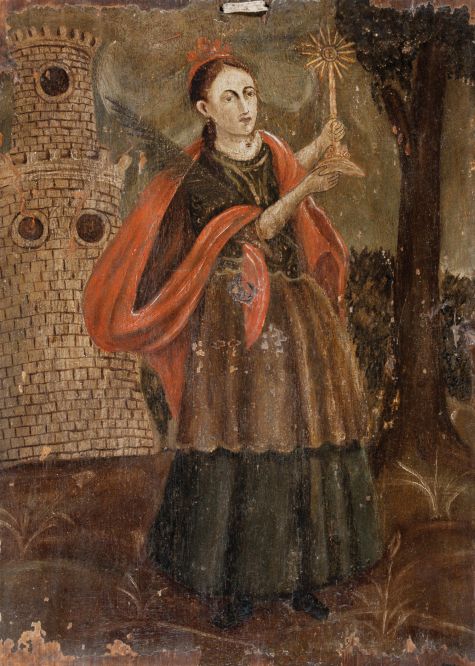
Santa Barbara, circa 1770
Retablo created by Don Bernardo Miera y Pacheco
from the Palace of the Governors.
Bernardo married María Estefania de los Dolores Domínguez de Mendoza, daughter of Salvador Domínguez and Ana Fraguagua, on 20 May 1741 at Iglesia del Presidio de San Felipe y Santiago de Janos, Chihuahua, , Nueva España..250 (María Estefania de los Dolores Domínguez de Mendoza was born in 1723 in Janos, Chihuahua, Nueva España. 250, baptized on 7 Jan 1723 in Janos, Chihuahua, Nueva España 250 and died on 13 Dec 1783 in Santa Fé, Nuevo Méjico, Nueva España.)
Noted events in their marriage were:
• Marriage Record. 252
The padrinos of the couple were don José Becerra (aka Bezerra) Nieto and Doña María Muñoz. The official witnesses to the union were don Pedro Becerra, Juan Antonio Guerra, and Salvador Domínguez. The presiding priest was Bachiller Tomás Becerra.
|